


Games Against Humanity: How we Quit Work for Play
 Jobs are boring - unless you're playing! What is play, really? The fact that there are many theories by prominent researchers like Jean Piaget, Carl Jung and Sigmund Freud are clear proof that the phenomenon is difficult to understand. Johan Huizinga defines play as "a free activity standing quite consciously outside 'ordinary' life as being 'not serious' but at the same time absorbing the player intensely and utterly." Play is most commonly associated with children and their juvenile-level activities, but play can also be a useful adult activity, and occurs among other higher-functioning animals as well. Kids tend to play with whatever they can find, pick up any household item and "fly" it through the air as to pretend that it is an airplane. However, when play is structured and goal-oriented, it becomes a game - with rules, challenges, and more importantly - a social interaction. When did we start pursuing voluntary, intrinsically motivated activities for enjoyment?


Games have been played in most cultures and societies throughout history; some even predate literacy skill development in the earliest civilizations. For instance, board games like backgammon can be traced back to 3000 BC in Persia. Ancient Egyptians used to play a board game similar to backgammon called "Senet" and was pictured in frescoes found in burial sites. What makes these games interesting is that it brings people together and promotes social interaction during gameplay. Modern findings in neuroscience suggest that gameplay promotes flexibility of mind, including adaptive practices such as discovering multiple ways to achieve a desired result, or creative ways to improve or reorganize a given situation.


Fast-forward to modern age, you can see that the fundamental of social gaming is the same today as what it was 5,000 years ago. Role-playing games (RPGs) like Dungeons & Dragons, in which players assume the roles of characters in a fictional setting, became very popular in the 70s. The game arrived to bring people together and encourage them to use their imaginations to greater levels. Together, the players collaborate on a story involving their characters; create, develop, and explore the setting. In other words, players experience an adventure outside the bounds of everyday life with their friends. With the onset of the Information Age, computers carried gameplay into virtual spaces and video games were born. Some of the earliest known video games were two-player games, including sports games like Tennis For Two (1958) and Pong (1972), shooter games like Spacewar! (1962), and racing games like Astro Race (1973). As processing power and connectivity increased, new genres were developed to form massively multi-player games based around real time networking.


Games have always used whatever technology was current: modems before the Internet, terminals before modems, and cardboards before screens. The expansion of online gaming has reflected the overall expansion of computer networks from small local networks to the internet and the growth of internet access itself. Its rise enabled video game player to come together and compete over servers, but the participation in the late 90s was largely limited only to the very enthusiastic. Facebook would bring it to the masses not long after launching in 2004. The huge growth of Facebook attracted great interest in the platform, from users and developers alike. Zynga was one of the early developers to seize upon the opportunity for social media gaming, with the 2009 launch of Farmville.


New forms of social gaming are emerging every month, and it is all thanks to the continual development of new technological devices, like mobile phones, joining in on the action. The gaming industry is beginning to embrace the value of social gaming, as seen by many sites incorporating social media functions into their online games, especially for games that appeal to demographic groups that otherwise play very few video games (like the elderly who play on mobile bingo sites from their smartphones, for example www.bingoonmobile.co.uk). Thus, the online gaming market expanded exponentially over the past decade, making online games a form of social activity beyond offline limits, and it seems like the future of social media gaming is shooting for infinity.
Click here to continue reading..


 Whether and to what extent we should simplify our lives and get "back to basics" is a debate that has been going on since the invention of writing. As the rate of technological progress increase at an accelerating pace, a counter trend is emerging where technological development is not inherently synonymous with progress. Proponents of Appropriate Technology (AT) argue that progress can only be achieved with technology that is designed with special consideration to what it is intended for.
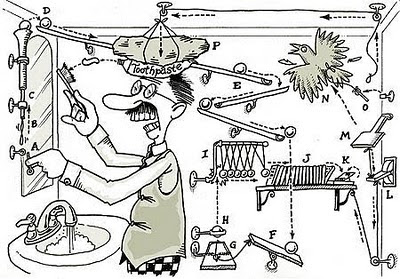 Anything you can do, a machine could theoretically do faster, better, more efficiently but is this really true? The GPS software on my cell phone, for example, can navigate me from one place to another much faster and more efficiently than a human navigator could except that the GPS stops working if I blunder into an area into which the network's signal won't reach. My calendar, which is on the Internet, can be reached from any computer or from my cell phone, and updated from both places. It will send me automated reminders to do things at a certain time but sometimes the reminders themselves will slow me down, or a reminder will come into my phone when I'm trying to talk to someone or when I'm trying to use that GPS locator -- oops, just missed that turn -- thanks, GCal.


 The first caveman didn't fight dinosaurs with a bag of lithium in his hand, he had a spear! He used his brain on how he could out wit the dinosaur and capture it for a feast. Studies do not prove that medication even works properly but one thing it does for certain is that it hooks you. Once you take that medication and continue it you need a long period of detoxification to completely free yourself.
  Oh sure, you may sit there nodding smugly but when you think about it - how well do we really know the world? Many probably know about the popular American TV show, "Are You Smarter Than A Fifth-Grader?" - but I think fifth graders are so overrated in an age of information and technology where even 2-year-olds can use the Internet. Without going any further
 Irregardless, could you care less? A bunch of Oxford
 Unfortunately designers' calmness might not last too long. What if you wake up one day to find out that the virtual model of your newly finished building (or just marketed piece of furniture) is available to be downloaded for free at Bit Torrent and it was downloaded few thousands times already? Some would say that you should be quite happy. It's a good design - few thousand downloads in few hours in not a common thing. But I wouldn't be surprised if you would feel the opposite asking where the heck will I get money from now?
 Finding an apartment in one of the world's most expensive cities is a grave matter, but some savvy renters in Tokyo have more than a ghost of a chance of finding prime digs – they seek to rent where someone else bought the farm. Imagine lying awake at night in your new apartment, restless and not yet accustomed to the usual night noises. Your mind drifts, then settles on the great deal you got on this place – and WHY you got it. A creak; a sigh; is it just the evening breeze, or something more sinister?
 The so-called suicide discount is an unwritten rule adhered to by most Tokyo real estate agents and doubtless by realtors worldwide. In Japan at least, the law compels real estate agents to make potential tenants aware if a death occurred in the unit being offered. One small catch is that the law applies only when the unfortunate event concerned the occupant immediately previous, but as one realtor admitted, "Even if we didn’t, neighbors would certainly tell new residents about the gruesome details."
 One curious point brought up by a Tokyo real estate company owner was that young women are the most typical renters of apartments with shady histories. "Men, rather than women, tend to be superstitious and think the place will be haunted by the victim or something," he stated. Women are also well-connected with the online real estate scene. "They exchange information on the availability of such places and what the rent is likely to be with each other online."


 Observing or own minds would not truly be objective. Standing in front of a mirror is essentially subjective in nature. The pursuit of understanding our minds is much like looking at a mirror. It is essential to analyze the human mind with our own minds’. It seems apparent that this aspect poses as a negative variable to such a study, but don’t we know best as to what using the human mind is like? We most apt for carrying out self-examination, hence we are most suited to analyzing the dual nature of our own minds.
 As the word "dual" implies there are two components of the human mind, as there are also two hemispheres of the human brain. Many individuals have summed up a collaboration between these dualities. We have realized that our mental divisions consist of {logic or reason}, and {intuition or emotion}. Moreover our brain is divided into the left and right hemispheres. Studies conclude that when specific mental tests were carried out people who were more engaged in rational logical thought had more activity or domination in the left hemisphere of their brain.
 Most of us are dominated by either the left brain or the right brain, and only a minority are dual brained. Dual brained (Dual minded) people’s thought processes are dominated by neither hemisphere, but are evenly balanced between both hemispheres. We must take into consideration that we use both hemispheres commonly, thus the designation of dominance only measures where someone's brain activity occurs most successively, not exclusively.
 Imagine a large ball on display in a special showroom. The left half the ball is blue and the right half of the ball is red. The ball has been designed with the blue half facing west and the red half facing east. Indeed this sounds very much like the beginning of word math quiz, but believe me its not.
 These extremists limit their vision by going either all the way left or the right even though in the middle you can gain a wider perspective. From unique perspective of the middle the ball is much more visible overall and acknowledged as being blue and red not just one or the other. Therefore the wider perspective from the middle becomes a much more desirable place from which one can view and even experience life. Consequently this is why the "hemispherical balance" is such a significant concept.
 Over a hundred centuries ago in a dusty corner of Mother Africa, human evolution may have leaped instead of crawled. Do the remains of Boskop Man foreshadow the future of humanity? And if so, why aren't these ultimate humans here now, instead of us?
 The path of human evolution has been anything but a straight line from past to present. Much like a growing tree or a flowing river, branches and tributaries appear off the main trunk and either thrive, or taper off and peter out. When the game is survival of the species, evolutionary adaptations are mercilessly judged by nature, red in tooth and claw.


 A scientific analysis of the Boskop fossils, "
 All right, if you've taken this leap of faith, consider what it means and where it leads. Boskop Man suddenly appeared, used his big brain and superior intelligence to create a technology so advanced that it allowed them to leave the Earth entirely, but... would they forget the place of their birth so easily? Consider what a Boskopoid would look like: huge, rounded heads, big wide eyes set into small, child-like faces - sound familiar? To paraphrase FDR, "we have met the aliens, and they are us!"
 This type of marriage is, not surprisingly, very rarely found around the Globe. It occurs among populations where there are fewer women than men. Female tendencies to find husbands out of a sack first appeared among traditional matriarchal societies. In such primitive groups there was a tradition to kill baby girls in order to reduce the occurrence of births. As a result the female population gradually decreased in comparison to the male population -- and thus the term, "It's a Man's World"?
 Polygamy, on the other hand, is when a woman or man is married to more than one spouse. Polygamy is a term which is most often used when describing how a man is married to more than one woman. This description is incorrect because the concept of polygamy means a situation where either a man or woman is married to more than one spouse. The situation where the man or woman is married to more than one spouse can be sorted into different sociological categories and concepts. These include how a man can be married to more than one woman (polygyny) and how a woman can be married to more than one man (polyandry).
  Although historically many societies witness single husband marriages, many women have married more than one man due to the geographical conditions and economic problems. For example; When there was limited land for usage in Tibet, a group of brothers all married the same woman. By marrying the same woman they were able to produce fewer children and avoid a split in their future inheritance. Consequently they were able to establish financial security to a certain degree.
 With a life increasingly built upon seeking the approval and status of the upper class, we seem to have forgotten the fundamental meaning of existence. Be it negligence, self-indulgence, excessive spending or ambivalence, we are all faulty for losing touch of reality and for failing to answer the cries of our future generation. Over 2 million children are forced in child prostitution every year. Despite this shocking amount there has been no real counter-effective action from governments and the numbers still show a cumulative curve.
 Aneta was 17 when her ordeal began. She was promised a job as an au pair to an affluent family when she decided to leave her Czech village and cross borders. She was recruited by Petr, a handsome man who promised that she would travel with them to London or even America. "You'll get to practice your English," he joked. The next day Aneta joined ten other local girls who handed over their passports and followed Petr into a life of ruins and defilement. Hours later instead of being welcomed by smiling families, they were greeted by a group of burly men who possessed guns and savage dogs. The girls, some of them as young as 14, were then forced into a room, stripped naked and pushed into a line. The men moved up and down, along the line and handled the girls roughly. They inspected their teeth, breasts and the areas between their legs. “We were just horseflesh” Aneta recalled. Each girl was flung across the room and gang raped. Within the next few days all of them were smuggled across Europe to work in brothels.
 In
In  It is almost impossible to stem out this societal problem because of an overlap of certain factors and other discrepancies. Voluntary willingness from children to exchange sex for tangible benefits, reflect a society where the sanctity of the physical intimacy has been torn apart by our very own assets. On the other hand menacing behavior on part of the perpetrators, expose the degradation of society’s morality.

